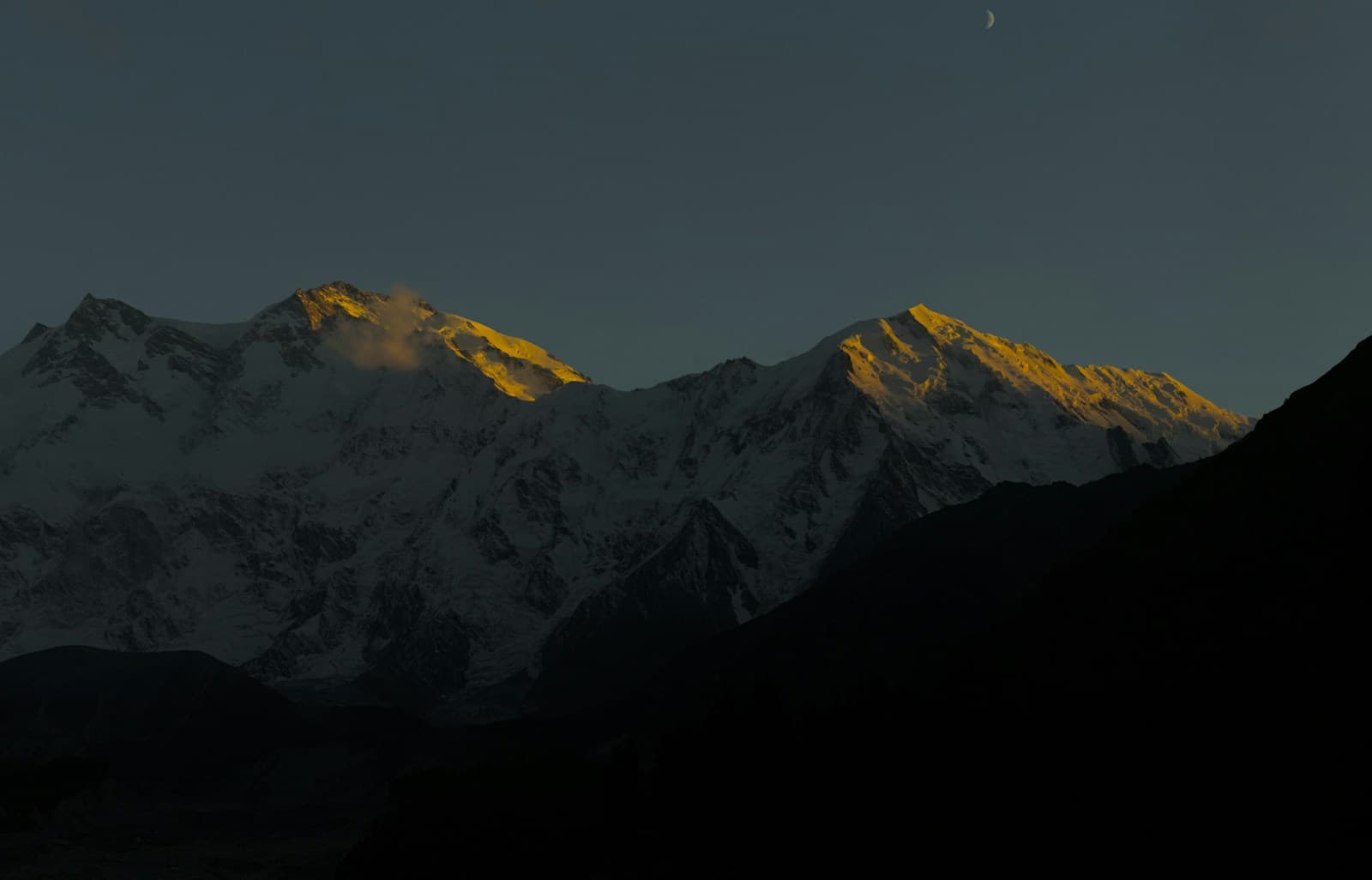
The K2 Base Camp trek is one of the world's great mountain journeys. It is also one of the most logistically demanding. This guide covers what you need to know before committing to it: the route, the fitness required, the permits, and the things most trekking guides gloss over.
The route
The standard approach to K2 Base Camp follows the Baltoro Glacier from Askole, the last village accessible by road. The route runs east along the Braldu River to Jhula, then up through Paiju camp (the last tree you will see for a week), onto the Baltoro Glacier itself, and through Urdukas and Gore camps to Concordia: the junction where the Baltoro meets the Godwin-Austen Glacier, and where K2 first becomes fully visible.
Concordia is the emotional heart of the trek. Here, four 8,000-metre peaks are visible simultaneously: K2 (8,611m), Broad Peak (8,047m), Gasherbrum I (8,080m), and Gasherbrum II (8,034m). The Trango Towers rise directly above the glacier. The scale is difficult to convey in photographs.
Planning a trip to Skardu?
Private 4×4, boutique hotels, and a day-by-day itinerary built around what you want to see.
Free PDF with the daily breakdown, hotels, costs, and the routes we use. No spam. Unsubscribe in one click.
From Concordia, a further half-day walk leads to K2 Base Camp itself at 5,150 metres.
Duration
Most trekkers allow 16 to 22 days for the full route: 7 to 9 days in, rest days at Concordia or K2 Base Camp, and 5 to 7 days out. The return can be faster than the approach. Some groups do a Gondogoro La crossing (a technical high pass at 5,585 metres) instead of retracing the full route: this requires previous glacier experience and adds two to three days.
Fitness requirements
This trek does not require technical climbing skills. You do not need crampons or an ice axe for the standard Baltoro route (the Gondogoro La crossing does require both). What you need is excellent base fitness, the ability to walk 6 to 8 hours per day on uneven glacier terrain, and tolerance for basic camp conditions.
The altitude is significant: K2 Base Camp at 5,150 metres and Concordia at around 4,690 metres are higher than most trekkers have been before. Acclimatisation is built into the schedule: rest days are not optional extras, they are necessary. Rushing the Baltoro is one of the main reasons treks fail.
Permits
Foreign trekkers require a Restricted Area Permit from Pakistan's tourism authority. This requires a licensed trekking guide. The permit takes several working days to process and must be arranged before departure for Askole. Prices change periodically: confirm current fees with your operator.
Pakistani nationals do not require the same permit but still need to register with the local authorities in Skardu before the trek.
Best season
The Baltoro is accessible from late June through August. July and August are peak season: the glacier is most navigable, the weather is as stable as it gets (which is still variable), and the high camps on K2 are active with climbing expeditions. Late June can have more unstable snow conditions. August begins to see some trekkers leave as weather deteriorates toward September.
The Baltoro in September is possible but the upper glacier can be icy and the weather less predictable. Most operators recommend July as the single best month.
What Raahi provides
We handle the pre- and post-trek logistics: private 4x4 transport to Askole, accommodation in Skardu before and after the trek, permit support, and introductions to experienced Baltoro guides and porters from our network. Many trekkers also spend 5 to 7 days acclimatising in the Skardu area (Deosai, Shigar, Khaplu) before the trek: we build this into the full itinerary.
We do not guide on the mountain itself. The Baltoro requires specialist high-altitude guides, and we connect you with the right team rather than providing generic trekking guides who may not know this specific glacier. See our trekking logistics service for details on what we cover.
Common mistakes
- Not building enough buffer days: weather can close the Skardu airport for 2 to 3 days at a time; plan for this at both ends
- Under-packing for cold: even in July, nights on the Baltoro are below freezing; sleeping bag rated to -15C minimum
- Booking the cheapest porters without checking experience: experienced Baltoro porters are worth the extra cost
- Skipping acclimatisation: arriving in Skardu and driving straight to Askole is a recipe for altitude problems above Urdukas
For the Skardu-side logistics before and after the trek, flights, acclimatisation days, and accommodation, see our Skardu complete travel guide and guide to Skardu flights. Get in touch to arrange K2 base camp logistics with Raahi.
Frequently Asked Questions
Do you need a permit to trek to K2 Base Camp?
Yes. The K2 Base Camp trek via the Baltoro Glacier requires a trekking permit from Pakistan's Ministry of Tourism, arranged through a licensed Pakistani trekking agency. Raahi can connect you with experienced local trekking operators who handle permits and logistics end-to-end. Get in touch for current permit requirements and costs.
How long does the K2 Base Camp trek take?
The standard route from Askole to K2 Base Camp (Concordia) and back takes 14 to 18 days, passing through Paiju, Urdukas, Goro II, and Concordia at around 4,700m before the base camp area at approximately 5,000m. Most trekkers add 2 to 3 days at Concordia to acclimatise and for the views of K2, Broad Peak, and the Gasherbrum group.
What is the best season to trek to K2 Base Camp?
June through August. June offers pre-monsoon stability with the route fully accessible; July and August are peak season when the trail infrastructure is operational and the weather most reliable. September is possible but conditions become unpredictable and snow can close higher sections. The window is narrow, plan and book permits well in advance.