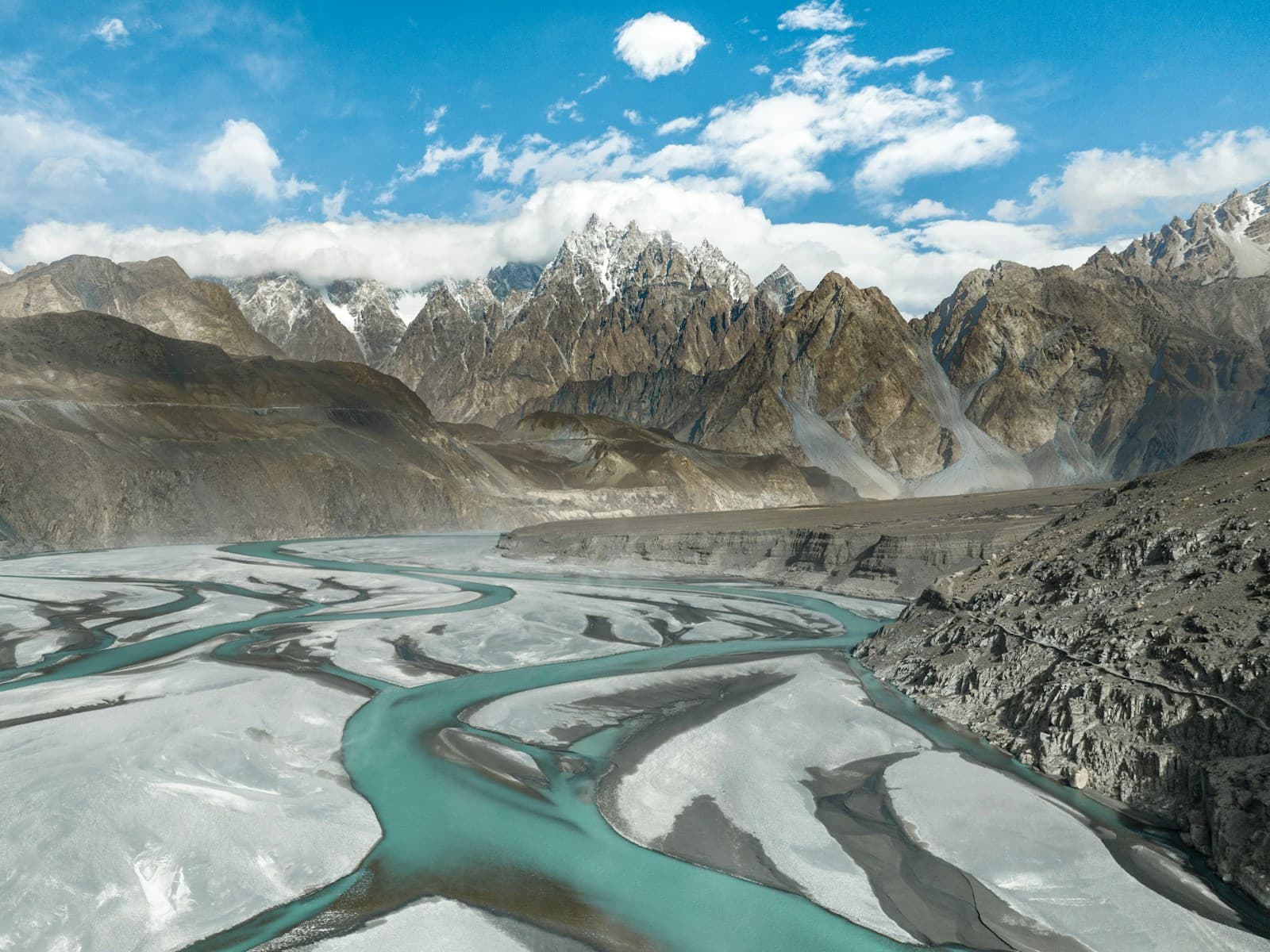
K2 is the second-highest mountain on Earth at 8,611 metres. Its base camp at 5,150 metres is reached by one of the world's great treks, a 10 to 12 day return journey from Askole village through the Baltoro Glacier, one of the largest non-polar glaciers outside the polar regions. The trek is demanding, the landscape is extraordinary, and it starts from Skardu.
This guide covers the full route, what permits you need, what it costs, the best time to go, and how to get from Skardu to the Baltoro. Raahi handles the transport side, 4x4 from Skardu to Askole, the last point reachable by vehicle.
The Route: Skardu to K2 Base Camp
The journey begins with a road transfer from Skardu to Askole village: approximately 100km through the Shigar Valley on rough 4x4 track, taking 4 to 6 hours. Askole (3,050m) is the last inhabited village on the route and the standard overnight before the trek begins. From Askole, the trek to K2 Base Camp covers roughly 130km return through one of the most dramatic trekking corridors on earth.
Planning a trip to Skardu?
Private 4×4, boutique hotels, and a day-by-day itinerary built around what you want to see.
Free PDF with the daily breakdown, hotels, costs, and the routes we use. No spam. Unsubscribe in one click.
The route follows the Braldu River to the snout of the Baltoro Glacier at Jhola, then traverses the glacier itself, walking on ice and moraine, through increasingly elevated campsites: Payu (3,450m), Khoburtse, Urdukas (4,100m), Goro II (4,350m), and finally Concordia (4,600m), where the Baltoro meets the Godwin Austen Glacier and K2 becomes visible in full for the first time. K2 Base Camp itself is a further two to three hours beyond Concordia at 5,150m.
The standard acclimatisation itinerary from Askole to Base Camp and back takes 10 to 12 days for fit trekkers. Adding side trips, Broad Peak Base Camp, Vigne Glacier, extends this to 14 to 16 days. Most trekking companies run 14 to 20 day packages including the Skardu transfer and the Concordia camp.
Key Campsites and Distances
- Askole to Jhola: 18km, 5 to 7 hours, camp at the glacier snout
- Jhola to Payu: 12km, 4 to 5 hours, first proper glacier camping
- Payu to Urdukas: 16km, 6 to 8 hours, views of Trango Towers
- Urdukas to Goro II: 14km, 6 to 7 hours, Masherbrum visible to the south
- Goro II to Concordia: 14km, 5 to 7 hours, first view of K2 at the junction
- Concordia to K2 Base Camp: 9km, 2 to 3 hours, highest point of the standard route
All distances are approximate. The glacier is dynamic and some sections change year to year. An experienced local guide is essential.
Permits and Documentation Required
The Baltoro Glacier and K2 Base Camp trek requires a No Objection Certificate (NOC) from the Ministry of Tourism, Government of Pakistan, plus a trekking permit from the Alpine Club of Pakistan. Foreign trekkers must also register at the Skardu PTDC office before departure. The permit process typically takes 7 to 14 days if done in advance from your home country through a licensed trekking operator.
Pakistani nationals require NOC approval but the documentation is simpler. Permits are not available at the trailhead, they must be arranged before your Skardu departure. See the Gilgit-Baltistan permits guide for a full breakdown of the documentation process.
Trekkers must hire a licensed guide (required by regulation) and a minimum number of porters per group. The regulations exist to protect local employment and are enforced at the Askole checkpoint.
Best Time for the Baltoro Trek
June through early September is the only viable trekking window. The glacier is most accessible July and August. June is possible but some snow bridges are still unstable. September is the driest month and the light is exceptional, but temperatures at Base Camp drop significantly below freezing at night and some support teams begin withdrawing by mid-September.
Peak season (July 15 to August 15) has the most trekkers and the most predictable conditions. The campsites are crowded at Concordia and K2 Base Camp. If you want a quieter experience, early July or late August offers similar conditions with fewer people.
Avoid October and beyond: the glacier is icier, crevasse bridges are deteriorated, and the weather window for high-altitude teams has closed. For the wider seasonal context, see the best time to visit Gilgit-Baltistan guide.
Fitness and Altitude Requirements
The K2 Base Camp trek is a serious undertaking. It is not technical climbing, no ropes, crampons, or ice axe are required for the standard Concordia/K2BC route, but the cumulative distance, altitude, and glacier terrain demand a solid base of fitness. You should be able to walk 6 to 8 hours per day for 10 consecutive days with a daypack, at elevations up to 5,150m.
Altitude sickness is a real risk above 4,000m. The acclimatisation schedule built into a standard 12 to 14 day itinerary manages this, but anyone with cardiovascular or respiratory conditions should consult a doctor before planning this trek. Spend at least two full days in Skardu (2,400m) before heading to Askole.
Cost Breakdown
A guided K2 Base Camp trek from Skardu typically costs USD 1,500 to 3,000 per person for a group of two to four, depending on the operator, the number of porters, and whether accommodation in Skardu is included. This covers:
- Government permit and NOC (approximately USD 80 to 150 per person)
- Licensed guide fee (approximately USD 50 to 80 per day)
- Porter fees (regulated government rates per porter per day)
- All camping equipment and food on the trail
- 4x4 transport Skardu to Askole and return
- Skardu accommodation pre- and post-trek
Raahi handles the Skardu-to-Askole 4x4 transport and Skardu accommodation; we work with licensed trekking companies for the guided trek itself. Message us with your dates and group size for current pricing.
What to Pack
The essentials for the Baltoro in summer: a 4-season sleeping bag (rated to -15°C), waterproof trekking boots (broken in), a down jacket and fleece midlayer, waterproof outer shell, sun protection (UV intensity at 5,000m is severe), trekking poles for the moraine terrain, water purification, and a medical kit including altitude medication (Diamox, discuss with your doctor before the trip).
Pack light: you will be carrying your daypack every day and paying porters for your heavier bag. Total kit weight including sleeping bag should be under 12kg in the porter bag.
Getting to Askole from Skardu
The Askole road branches off the main Skardu to Shigar route about 25km east of Skardu. From the junction, the road deteriorates significantly: 75km of rough 4x4 track along the Braldu River valley, crossing several bridges and traversing landslide sections. A capable 4x4 (Land Cruiser 70-series or equivalent) with an experienced driver is non-negotiable. The drive from Skardu typically takes 4 to 6 hours depending on road conditions.
Raahi runs the Skardu-to-Askole transfer as part of any trekking package. We use vehicles and drivers who know the route. If you are organising your own permit and guide independently, contact us for the transport leg.
See the Raahi trekking tours page for our full approach to guided trekking in Baltistan, or get in touch to start planning your K2 trek.
Frequently Asked Questions
How long does the K2 Base Camp trek take?
The standard return from Askole to K2 Base Camp via Concordia takes 10 to 12 days for fit trekkers. Most operators build a 14 to 16 day package to allow for rest days, acclimatisation, and the Skardu transfer. Add Broad Peak Base Camp as a side trip and you are looking at 16 to 18 days on the trail.
Do I need a permit for K2 Base Camp?
Yes. Foreign trekkers need a No Objection Certificate (NOC) from Pakistan's Ministry of Tourism and a trekking permit from the Alpine Club of Pakistan. You must also register at the Skardu PTDC office. Permits take 7 to 14 days to arrange and must be in hand before the Askole checkpoint. See the Gilgit-Baltistan permits guide for the full process.
How difficult is the K2 Base Camp trek?
Strenuous but non-technical. No climbing experience or special equipment required. You need to be able to walk 6 to 8 hours per day for 10 consecutive days at altitudes up to 5,150m. The glacier terrain (moraine, loose rock, some snow in June) adds difficulty. Solid hiking fitness and a respect for altitude acclimatisation are the requirements.
What is the best time for the K2 Base Camp trek?
July and August are the most reliable months: warmest temperatures at camp, most stable glacier conditions, and the widest weather windows. June is viable but some snow bridges are still forming. September is drier and less crowded but colder at high altitude, and some support teams start withdrawing mid-month.
Can I do the K2 Base Camp trek independently?
No, Pakistani regulations require all foreign trekkers on the Baltoro to be accompanied by a licensed guide and to have arranged permits in advance. You cannot hire a guide at the trailhead; all arrangements must be made through a licensed trekking operator before departure. Independent camping on the Baltoro without a permitted guide is not permitted.