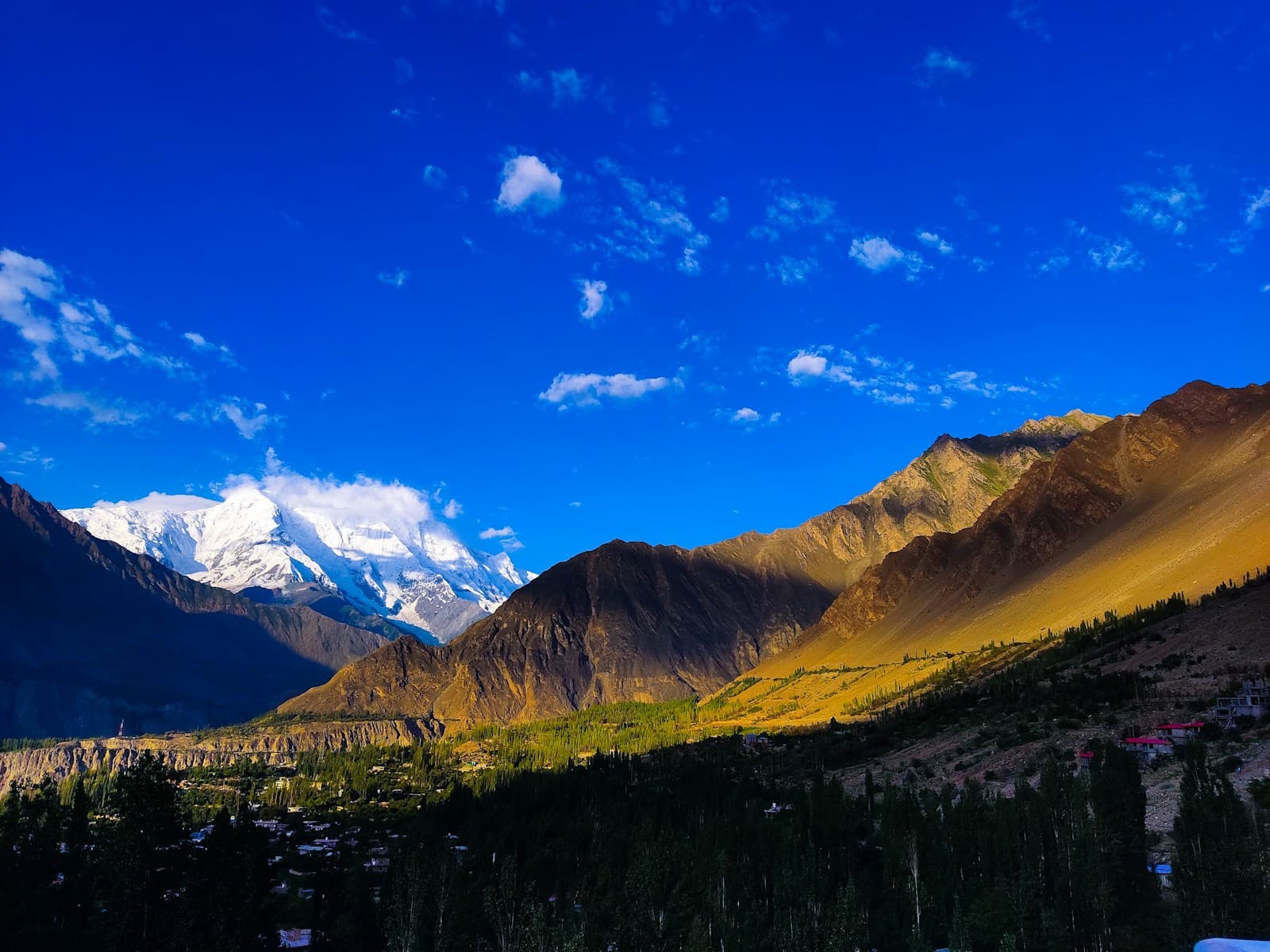
Karimabad is the main settlement of Hunza Valley and the place most visitors use as their base for upper Hunza. It sits at around 2,400 metres on a broad terrace above the Hunza River, with Rakaposhi (7,788m) visible to the south and Ultar Sar (7,388m) rising directly behind the village to the north. If you want to understand old Hunza, its forts, its history, its landscape, Karimabad is where you start.
Getting to Karimabad
The standard route is to fly to Gilgit from Islamabad on PIA or SereneAir. The flight takes around 45 minutes and is the same route that bypasses two days of road travel. Gilgit airport is more reliable than Skardu and operates year-round more consistently. From Gilgit airport, Karimabad is about 100km north along the Karakoram Highway, roughly two hours by road depending on your vehicle and the traffic through Gilgit town.
If you are coming by road from Islamabad, the total journey is 14 to 16 hours on the KKH through Abbottabad, Besham, Chilas, and Gilgit. It is a long day or a comfortable overnight with a stop. The road is good for most of the route, with a short stretch through Kohistan that deserves more alertness. Driving is the better option if you want to see the transition from the plains through the mountains at your own pace, or if flights are cancelled due to weather.
Ready to plan your trip?
Tell us where you want to go and how long you have. We build the itinerary around what matters to you.
Free PDF with the daily breakdown, hotels, costs, and the routes we use. No spam. Unsubscribe in one click.
The Old Town and the New Bazaar
Karimabad has two distinct parts and it is worth spending time in both. The new bazaar (sometimes called Karimabad bazaar) sits lower on the terrace and is where you will find most of the hotels, restaurants, and shops. The shops sell dried apricots, gemstones, carved walnut items, and woollen goods, the quality varies, but the dried fruit is uniformly good. The bazaar is compact, easy to walk, and busy in peak season without being overwhelming.
Above the bazaar, the old town climbs steeply towards Baltit Fort. The lanes here are narrower, quieter, and more interesting architecturally. The views from the upper lanes, across the terraced apricot orchards to the valley below, are some of the best you will get without going higher. If you have only an afternoon before or after the fort, walk up through the old town rather than taking the jeep track.
Baltit Fort
Baltit Fort is around 900 years old and sits on a promontory directly above the old town. It was the seat of the Mirs of Hunza until the mid-20th century and was restored by the Aga Khan Trust for Culture over several years in the 1990s. It is on the UNESCO World Heritage tentative list and is one of the better-preserved royal fortresses in the western Himalayas.
Entry requires a ticket, bought at the gate. The walk up from the bazaar takes around 20 minutes on a clear path. Inside, the rooms are furnished and interpreted, and the staff are usually willing to explain the history of specific areas. The roof terrace gives a direct view down into the old town and across to Rakaposhi. See the full Baltit Fort guide for more detail on the interiors and what to expect.
Altit Fort
Altit Fort predates Baltit by a century or more, some estimates put it over a thousand years old, and sits about 4km from Karimabad above the village of Altit. It is less visited than Baltit, which is part of its appeal. The fort has also been restored by the Aga Khan Trust and the surrounding village has been partially conserved, giving a sense of how pre-modern Hunza settlements were organised.
The approach from the Altit village side gives a different perspective on the valley than Karimabad offers. Worth half a day, and easy to combine with the drive back via the lower river road.
The Views: Rakaposhi and Ultar Sar
The combination of close, high peaks is what makes Karimabad visually distinctive. Most viewpoints in Pakistan require travel to see mountains of this scale. In Karimabad, Rakaposhi is simply there to the south, visible from the bazaar, from hotel terraces, from the road. Ultar Sar is directly behind the village, so close that it fills the upper quarter of the sky when you look north from the fort.
Sunrise from the upper old town or from the lanes above the bazaar catches Rakaposhi first, while Ultar Sar takes longer to clear the morning cloud. Golden hour in the evening is the reverse. See the Rakaposhi viewpoint guide for the best spots across the valley.
Duikar and the Eagle's Nest Viewpoint
Duikar is a small settlement about 30 to 45 minutes by jeep above Karimabad, at roughly 3,100 metres. The viewpoint here, usually called Eagle's Nest, looks back down into Hunza Valley and across to five distinct mountain ranges simultaneously: Rakaposhi, Ultar Sar, Diran, the main Karakoram chain to the east, and the Hindu Kush ranges to the northwest.
The best time is sunrise, before the valley haze builds. You will need a jeep and a driver willing to leave by 5am from Karimabad, most hotels can arrange this. Late afternoon, from around 4pm, is the second choice. Midday is usually not worth the trip.
Apricot Season
The valley is most celebrated during apricot blossom, which runs from mid to late April most years. The trees on the terraces below Baltit Fort and around the old town flower white and pink for two to three weeks. It is a genuine natural event rather than a managed display, and the combination of blossom, old fort, and high peaks behind makes for exceptional photography.
Apricot harvest comes in July. The fruit is dried on flat rooftops across the village, visiting during harvest is less photogenic than blossom but more viscerally interesting. The dried apricots sold in the bazaar are a direct product of this, they are worth buying here rather than in Gilgit or Islamabad, where freshness varies. Check the best time to visit guide for a full seasonal breakdown.
Food in Karimabad
Hunzai food is distinct from the chapati-and-curry standard that dominates the rest of Pakistan. The items worth seeking out:
- Chapshuro, a thick flatbread filled with minced meat and onion, cooked on a griddle. Found in several small restaurants in the bazaar.
- Diram fiti, a traditional buckwheat bread, denser and earthier than wheat bread. Less common now but still made in some households and occasionally in restaurants.
- Dried apricots, eaten as a snack or with butter. Buy from the bazaar shops rather than roadside stalls on the highway.
- Walnut oil, used in cooking and sold in small bottles. A good item to take back.
The restaurants in the bazaar are basic but reliable. Most serve daal, rice, and local bread alongside the regional specialities. For where to stay in Hunza, the hotels on the upper edge of the bazaar have the best views and are walking distance to both the bazaar and the fort trail.
Day Trips from Karimabad
Karimabad is well positioned for the main sites in central and upper Hunza:
- Attabad Lake, 45 minutes south by road. A turquoise lake that formed in 2010 after a landslide blocked the Hunza River. The colour is striking. Boat trips are available. Easy half-day.
- Passu Cones, 1.5 hours north. The Passu Cones viewpoint and the Hussaini suspension bridge are the two attractions here. The bridge walk is not for people uncomfortable with heights. Full day with Passu village exploration.
- Khunjerab Pass, 3.5 hours north, at 4,693 metres on the Chinese border. The highest paved international border crossing in the world. Altitude effects are real at this height, acclimatise in Karimabad for two nights before attempting it.
How Long to Spend in Karimabad
Two nights is the minimum to cover Baltit Fort, a walk through the old town, Altit Fort, the Eagle's Nest at sunrise, and time in the bazaar. Three nights allows you to add an Attabad Lake day trip without feeling rushed. Four nights or more makes sense if you are combining with Passu and upper Hunza.
If you are planning a wider Hunza trip, the 5-day Hunza itinerary maps out a sensible sequence from Karimabad through Passu to Khunjerab and back.
Frequently Asked Questions
Where is Karimabad?
Karimabad is the main town of Hunza Valley in Gilgit-Baltistan, northern Pakistan, sitting at around 2,400 metres on a terrace above the Hunza River. It is roughly 100km north of Gilgit on the Karakoram Highway, about 2 hours 30 minutes by road, and around 300km from Skardu. Rakaposhi (7,788m) is visible to the south and Ultar Sar (7,388m) rises directly behind the village.
How do I get to Karimabad?
The quickest route is to fly from Islamabad to Gilgit (around 45 minutes on PIA or SereneAir), then drive north on the KKH for about two and a half hours, Karimabad is 100km from Gilgit. By road from Islamabad the total journey is 14 to 16 hours. Gilgit airport operates more reliably year-round than Skardu.
How long should I spend in Karimabad?
Two nights minimum to cover Baltit Fort, Altit Fort, Eagle's Nest at sunrise, and the bazaar properly. Three nights if you want to add a day trip to Attabad Lake without rushing. Four nights or more if you are continuing to Passu or Khunjerab Pass.
What is the best time to visit Karimabad?
April for the apricot blossom, mid to late April most years, when the terraces around Baltit Fort are in flower. September and October are the most reliable for weather and visibility, with fewer crowds than the July-August peak. Avoid November to March unless you specifically want winter conditions.