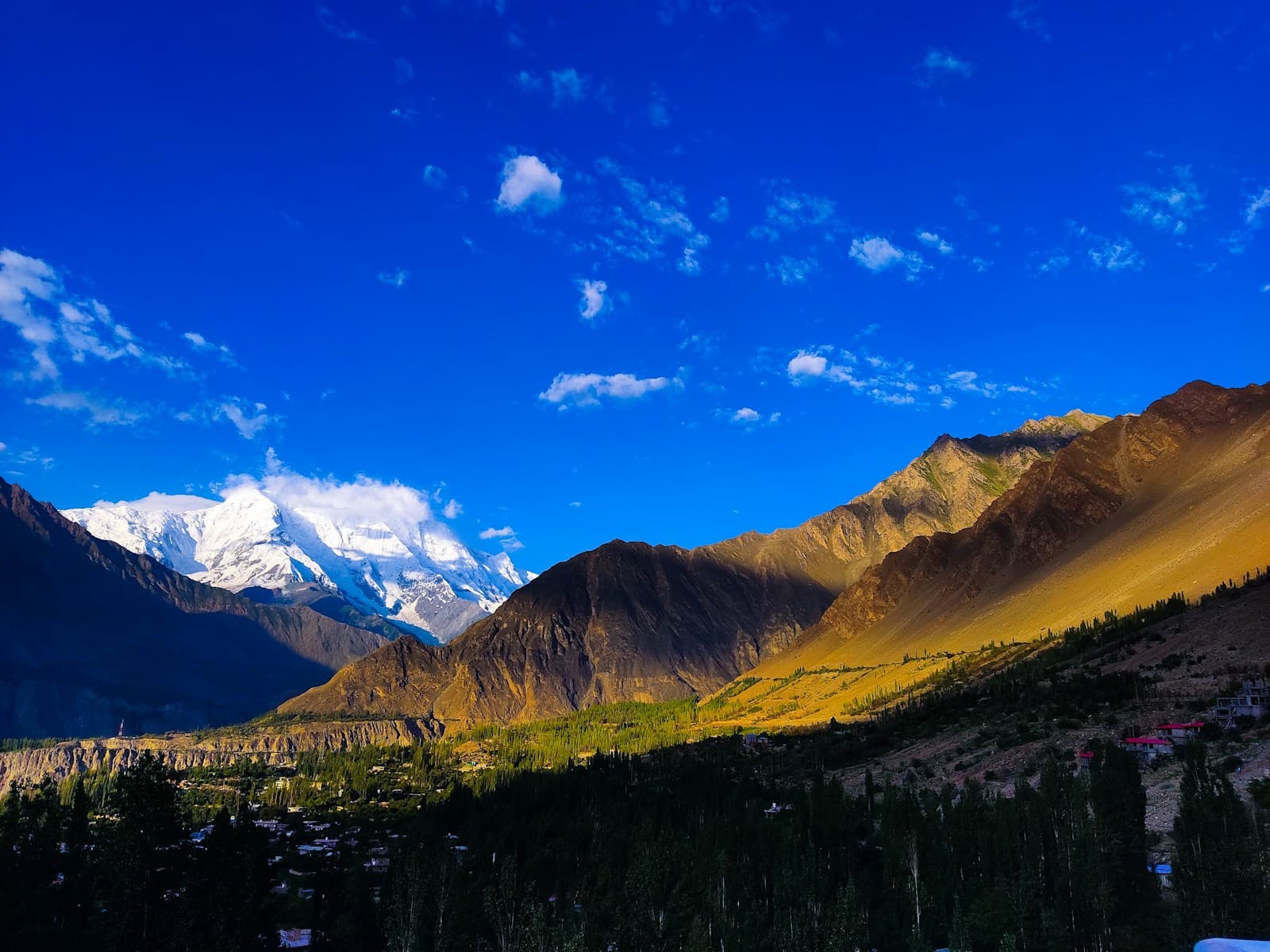
At 3,100 metres above Karimabad, the Duikar viewpoint, almost universally called Eagle's Nest, gives you the most complete mountain panorama in Hunza. From a single point you see five distinct ranges simultaneously: Rakaposhi (7,788m) directly across the valley, Ultar Sar (7,388m) looming above Karimabad to the northeast, Diran (7,266m) to the southwest, the main Karakoram chain stretching east toward Hispar, and the Hindu Kush ranges visible to the northwest on a clear day.
It is about 45 minutes by jeep from Karimabad on a rough, steep road that requires a 4x4. The elevation difference from the valley floor is around 700 metres. Most people go at sunrise or sunset, when the light hits the peaks from a low angle and the valley below fills with shadow. Midday visits are possible but the flat light flattens the peaks.
What You Can See from Eagle's Nest
The panorama divides roughly into three arcs. To the south and southwest: Rakaposhi fills the horizon, at 7,788 metres it is one of the most dramatic mountains visible from any roadside viewpoint in Pakistan, and from Duikar you have it across the full width of the valley. Diran (7,266m) sits to its right, lower but still commanding.
Planning a trip to Hunza?
Rakaposhi, Attabad Lake, Baltit Fort, Raahi plans it privately, at the pace you want.
Free PDF with the daily breakdown, hotels, costs, and the routes we use. No spam. Unsubscribe in one click.
To the north and northeast: Ultar Sar rises steeply directly above Karimabad, its glaciers visible from the viewpoint. The Batura Glacier stretches away to the northwest. On exceptionally clear days, usually October or early June before heat haze builds, the Hindu Kush peaks across the border are visible.
Directly below: the Hunza Valley floor, the Hunza River tracing a silver line, the patchwork of Karimabad's apricot orchards and terraced fields. At sunrise the valley is in deep shadow while the peaks catch the first light. At sunset the sequence reverses: the valley glows first while the peaks hold colour longest.
Sunrise vs Sunset: Which Is Better
Both are excellent. Sunrise is logistically harder, you leave Karimabad at 4:30 to 5:00am depending on the season to be at the viewpoint before first light, but the rewards are greater. The low-angle light hits Rakaposhi's southwest face directly, turning it from orange to white as the sun climbs. The valley below stays in blue shadow for 30 to 40 minutes after the peaks are lit, which gives the scene unusual depth.
Sunset is more popular and easier: drive up in the late afternoon, watch the light change over two hours, drive back in the dark with a headlamp. The western light hits Rakaposhi's face differently, more diffuse, warmer, and Karimabad's lights beginning to come on below make the scene feel inhabited in a way the pre-dawn silence does not.
If you can only go once, go for sunrise. If you are staying overnight at Eagle's Nest Guesthouse, you can do both.
Getting to Eagle's Nest
The road to Duikar branches off the main Karimabad road and climbs steeply for approximately 8 kilometres. A 4x4 or jeep is required, the surface is unpaved, loose in places, and narrow. Sedans are not suitable. Most visitors hire a vehicle through their hotel in Karimabad for PKR 1,500 to 2,500 return, depending on waiting time.
There is no public transport to Duikar. Taxis from the Karimabad bazaar are available but negotiate the price before departing. If your hotel is at Eagle's Nest Guesthouse, their vehicle can pick you up from the valley.
The road is navigable year-round except immediately after heavy snowfall, which occasionally closes it from December to February. In shoulder months (March, November), check with locals about road conditions before attempting it after cold nights.
Staying at Eagle's Nest Guesthouse
Eagle's Nest Guesthouse occupies the viewpoint itself, the hotel rooms open directly onto the panorama. Accommodation is basic: simple rooms, limited hot water, no luxury. The draw is the location. Waking before dawn, stepping outside, and having the five-range panorama entirely to yourself before the day-trippers arrive is worth the basic conditions for most visitors.
The guesthouse has a restaurant that serves meals throughout the day. Portions are straightforward Pakistani cooking, daal, rice, chapati, omelettes, at valley prices. You do not need to be staying overnight to eat here; many visitors who drive up for sunrise or sunset stop for tea or a meal.
Book ahead in peak season (July and August) as the guesthouse has limited rooms. In shoulder months, walk-in availability is more likely.
How Long to Spend
If you are driving up for sunrise or sunset, plan two hours at the viewpoint itself. The light changes slowly: arriving 30 minutes before the event and staying 30 to 45 minutes after gives you the full arc of colour. Add 45 minutes each way for the drive.
If you are eating at the restaurant, allow an additional hour. If you are exploring the Duikar village trails above the guesthouse, there are simple walking paths that gain another 100 metres of elevation and offer different angles on the panorama, add another hour.
Overnight visitors typically spend one full evening and one morning at the viewpoint before descending. That covers both the sunset and sunrise light and gives you the quietest hours of both.
When to Go
The viewpoint is accessible from April through November. Peak clarity is in October (autumn, after the dust of summer settles) and in early June (before heat haze builds). July and August have the most visitors and the most thermal haze; mornings are clearest before 9am. September is excellent: cooler, clearer, and less crowded than peak summer.
Winter visits (December to March) are possible but cold, temperatures at 3,100 metres can drop to minus 10 to minus 15°C at night. The road may be icy. The views in clear winter conditions are extraordinary, but the logistics require preparation. For a first visit, May to October is the reliable window.
For the full month-by-month picture of Hunza, see the guide to best time to visit Gilgit-Baltistan.
Combining Eagle's Nest with Other Karimabad Sights
Most visitors fit Eagle's Nest into a Karimabad day that also includes Baltit Fort and Altit Fort. A typical sequence: Eagle's Nest at sunrise, breakfast in Karimabad, Altit Fort mid-morning, Baltit Fort before lunch, afternoon free. This is a full day but not rushed.
The Rakaposhi viewpoint at Minapin is a different perspective on the same peak, closer, at road level, and pairs well with Eagle's Nest if you want to see Rakaposhi from two very different elevations. Minapin is about 35 kilometres from Karimabad, an easy detour on the KKH.
For the upper Hunza extension to Passu, see the guide to Passu Cones and Hussaini Bridge. For where to base yourself while doing all of this, see the Hunza hotels guide. For a full itinerary including Eagle's Nest, see the 5-day Hunza itinerary.
Frequently Asked Questions
How do I get to Eagle's Nest from Karimabad?
Eagle's Nest (Duikar viewpoint) is about 8 kilometres from Karimabad on a rough unpaved road that gains 700 metres. A 4x4 or jeep is required, sedans cannot manage the surface. The drive takes 40 to 50 minutes. Most visitors hire a vehicle through their hotel in Karimabad for PKR 1,500 to 2,500 return. There is no public transport.
Can you stay overnight at Eagle's Nest?
Yes. Eagle's Nest Guesthouse sits at the viewpoint itself and offers basic rooms with direct views of the Hunza Valley and the surrounding peaks. Hot water is limited and conditions are simple, but waking before dawn with the panorama outside your window is the main draw. Book ahead in July and August.
What can you see from Eagle's Nest?
From the Duikar viewpoint at 3,100 metres you can see five mountain ranges simultaneously: Rakaposhi (7,788m) directly across the valley, Ultar Sar (7,388m) above Karimabad, Diran (7,266m) to the southwest, the main Karakoram chain to the east, and on clear days the Hindu Kush to the northwest. The Hunza Valley floor is 700 metres below, with Karimabad's village and apricot orchards visible.