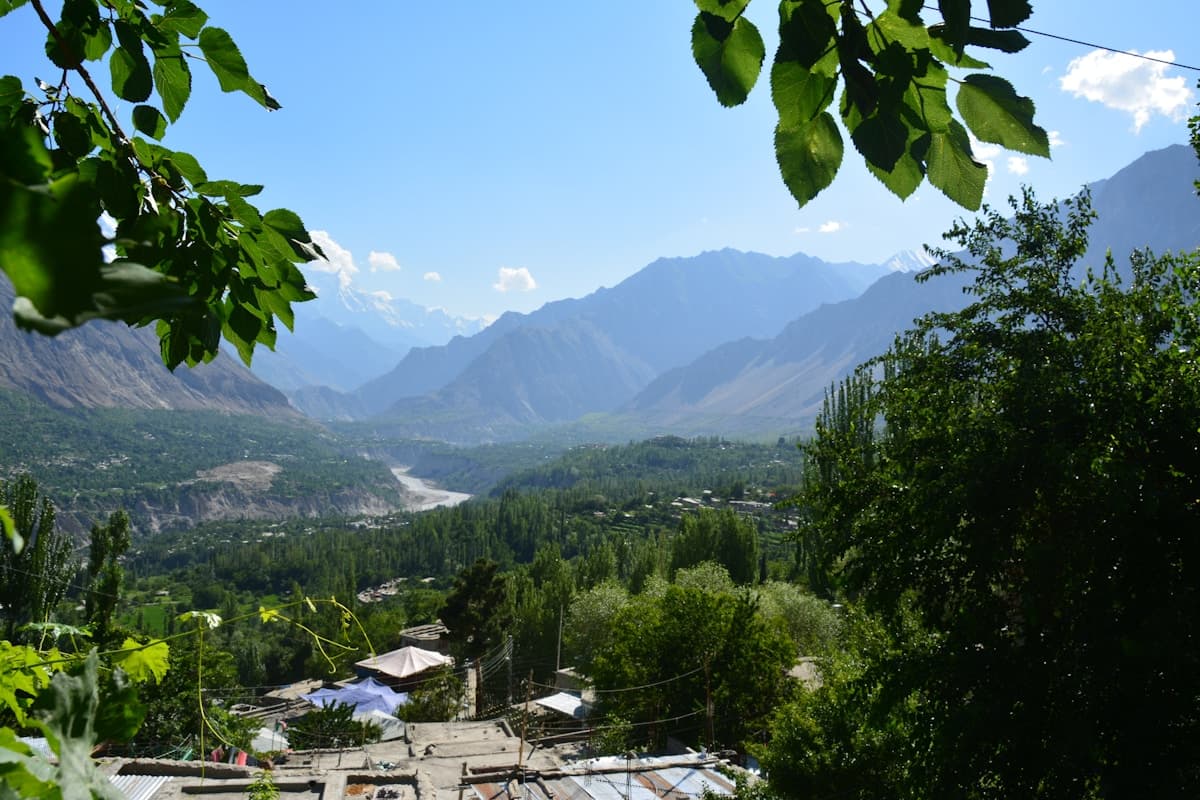
Rakaposhi (7,788m) is the twelfth-highest mountain in Pakistan and one of the most visually dominating peaks in the Karakoram. From the valley floor near Minapin, it rises approximately 5,800 metres above the road in a single continuous face, one of the greatest vertical rises from base to summit anywhere in the world. You can see it from the Karakoram Highway for much of the drive through Hunza, but the purpose of the Minapin viewpoint is to see it properly: standing still, with nothing between you and the mountain except open air.
Where to see Rakaposhi
The most direct viewpoint is the Rakaposhi Viewpoint roadside stop near Minapin village, roughly 45 kilometres south of Karimabad on the KKH. This is where buses stop and most travellers who are passing through get their photograph. It takes five minutes and gives you the standard view: the mountain filling the sky above the road.
A better approach is the Hunza Valley view from Duikar (Eagle's Nest) at 3,100 metres, with Rakaposhi across the valley to the south, the whole mountain profile visible from summit to glacier. From this height, you see it as it actually is rather than as a truncated skyline above a road. Dawn from Eagle's Nest, with Rakaposhi lit from the east, is one of the most reliably striking viewpoints in Gilgit-Baltistan.
Ready to plan your trip?
Tell us where you want to go and how long you have. We build the itinerary around what matters to you.
Free PDF with the daily breakdown, hotels, costs, and the routes we use. No spam. Unsubscribe in one click.
The Minapin base camp trek
From Minapin village, a well-established trail climbs toward Rakaposhi Base Camp through forest, Alpine pastures, and moraine terrain. The base camp sits at approximately 3,500 metres and takes 3 to 4 hours to reach on a steady ascent from the village at 1,700 metres. The altitude gain is around 1,800 metres.
The trail passes through Hapakun meadow at around 3,200 metres, which gives you the best mid-point view of the Minapin Glacier and the lower flanks of Rakaposhi before the final push to base camp. Most day trekkers turn around at Hapakun: the views are excellent, the grade up to base camp from there is steeper, and reaching base camp and returning to the village in a single day requires an early start (5 to 6am from the village).
The base camp itself looks directly up at the Minapin Glacier and the southwest ridge of Rakaposhi. The scale at this range, you are effectively standing at the foot of the mountain, is different from any roadside viewpoint. This is a serious day hike, not a stroll: proper footwear, water, food, sun protection at altitude, and ideally a local guide from Minapin village (available at the trailhead) are all recommended.
How to get there from Karimabad
Minapin village is 45 kilometres south of Karimabad by road along the KKH, approximately 45 to 50 minutes by private vehicle. The village is well-signposted from the highway. Guides for the base camp trek are available in the village; hiring one is straightforward and adds significant value for the navigation and cultural context.
Combining the Minapin trek with a Karimabad to Gilgit drive is the natural way to do it if you are moving on from Hunza: leave Karimabad in the morning, stop at Minapin for the base camp approach (or just the viewpoint stop), and continue to Gilgit in the afternoon. This adds 4 to 5 hours to the drive day but avoids requiring a dedicated side trip.
Best time of day
Morning, without question. Rakaposhi faces roughly south and southwest. In the morning, direct sunlight hits the face and the mountain is clear. By early afternoon, cloud frequently builds around the summit and the lower flanks can be obscured. The roadside viewpoint at Minapin is most rewarding between 7am and 11am. Eagle's Nest in Karimabad is best at sunrise, the mountain is fully lit and the valley is still in shadow below, which creates the most dramatic visual separation between peak and valley floor.
Photography notes
From the roadside viewpoint, use the KKH itself or the Hunza River bridge as a foreground element to give scale. From Eagle's Nest, the valley geometry does the work: shoot wide to include both the Rakaposhi face and the valley below in the same frame. The Minapin glacier approach gives close-range glacier textures and rockface detail that no roadside viewpoint can replicate. A telephoto lens (200mm or longer) allows you to isolate the summit ridge and glacier from base camp range.
Rakaposhi is visible from the road during most Raahi itineraries that include Hunza. Our Baltit Fort guide and Hunza destination page cover what else to see in the valley. For trekkers interested in a multi-day approach, see our trekking support page. The Minapin base camp day hike can be arranged as part of any Hunza itinerary, ask us to include it when you get in touch.
Frequently Asked Questions
Can you see Rakaposhi from Karimabad?
Yes, clearly, Rakaposhi is directly visible from Karimabad across the valley. The best views from town are from the lanes above the bazaar and from the Eagle's Nest viewpoint at Duikar (3,100m), 45 minutes above Karimabad by road. Eagle's Nest gives you the full mountain profile from summit to glacier; the KKH roadside viewpoint near Minapin gives you the mountain more directly above you.
How hard is the trek to Rakaposhi base camp?
Moderate to strenuous for an untrained walker. The Minapin base camp trek involves 1,800 metres of altitude gain over 3 to 4 hours, starting from the village at 1,700m and arriving at base camp at approximately 3,500m. Good physical fitness, proper footwear, and an early start (5 to 6am) are required for a comfortable day return. Hiring a local guide from Minapin village is strongly recommended for first-time visitors.
What is the best time to see Rakaposhi?
Morning, between 7am and 11am. Rakaposhi faces southwest and is fully lit by the sun in the morning. By early afternoon, cloud frequently builds around the summit. From Eagle's Nest in Karimabad, sunrise is the optimal time: the mountain is lit and the valley is still in shadow, creating the strongest visual contrast. The June to September period gives the most consistently clear mornings.
Where is the Rakaposhi View Point, and how do you get there?
The Rakaposhi Viewpoint is a roadside stop on the Karakoram Highway near Minapin village, about 45 kilometres south of Karimabad, roughly 45 to 50 minutes by private vehicle. It is well-signposted from the highway. For a fuller view of the mountain's whole profile rather than the roadside angle, Eagle's Nest at Duikar (3,100m), 45 minutes above Karimabad, looks across the valley at Rakaposhi in its entirety.